AirPort by Lupo IO
Remember what matters.
AirPort, by Lupo IO, a living memory substrate. Observations are read once, meaning is extracted onto one shared timeline, and the raw leaves the working path. What persists is meaning: with lineage, with evidence, with outcomes.
A new substrate
AI was built for tomorrow. Your data stack was built twenty years ago.
Traditional databases were designed for people running queries. Modern AI systems require continuously evolving, connected intelligence operating at machine speed.
Lupo transforms raw information into a living substrate of relationships, memory, and meaning, continuously organizing the world's information as it changes.
Every analytical system on Earth does the same thing with data: compute an insight, use it, throw it away, and compute it again tomorrow. The world re-derives the same understanding millions of times a day, forever. AirPort inverts this: the expensive reading happens once; what's stored is the meaning, permanent, typed, time-anchored objects, and the raw bytes leave the working path.
Continuously ingest
Photographs, headlines, sensor readings, filings, market events, conversations, all landing on one shared timeline.
Continuously understand
The expensive reading happens once. Observations are read, typed, and connected. What's stored is the meaning.
Continuously optimize
The most valuable meaning stays close to compute. Evidence rests in the basement, reachable but never re-read.
Proof
History once. Every day forever.
Overnight, AirPort read 23 years of the entire US equity market — 12,000+ companies, every exchange and dark pool, billions of observations — and distilled it into a permanent memory of what mattered. Zero failed days. And it no longer stops at markets: 40 live data sources now share one timeline — news, filings, satellites, shipping, prediction markets, the physical world itself — kept current in minutes a day, unattended. Ask it anything; answers come back in seconds.
Five layers. One clock. One question, what happened?, answered from stored meaning. Any name, any day.
All the way down
A satellite pixel, followed down to the coordinate.
Every day, the same thermal satellites that spot wildfires pass overhead and measure the temperature of the ground, reporting anywhere running unusually hot. On their own, those readings are anonymous: a location in southern Taiwan is hotter than expected. Nothing more.
We make it mean something. We match every thermal reading against the known location of every fab. An anonymous hotspot becomes a dated event at a specific maker's facility. The satellite tells us where the heat is; our map tells us whose it is.
That match doesn't become another alert. It becomes a span, the system's atomic unit of memory: a small, dated, self-describing fact about something that happened, at a precise moment, to a specific entity. And the instant it exists, it stops being alone and starts connecting.
It connects to the maker's own story. The heat event now sits on one timeline beside that company's trading, its shipments, the chemicals moving through customs, its news. So we can ask, immediately: did volume move? did options flow shift? did headlines turn? Because they're all just spans on the same clock, under the same identity.
It reaches through the supply chain: we follow it down to the firms whose products depend on that fab, and up to the suppliers feeding it. One hot pixel can light a whole web of related names. We even watch customs for the specialist chemicals moving in, an independent read on whether a fab is genuinely running or genuinely stopped.
And it correlates with everything else happening at that instant: news, conversation, prediction markets, weather, earthquakes. A tremor near one plant is never judged alone; it's weighed against whether the market was already nervous, whether several fabs were hit at once, whether customs had already begun to slow. That's how the system tells a one-off headline from a building risk.
Given only what was knowable that day, how often did disruptions like this actually matter, and for whom?
a satellite pixel, followed all the way down to a base rate · same object, one clock
Then the part that matters most. Every span is frozen at the moment it was knowable, never rewritten, never backfilled with what only became clear later. So history can be replayed honestly. A hotspot from three years ago reconstructs exactly what someone watching that day would have seen: the heat, the news then available, the prices then, the shipments then, and only after that does history roll forward to reveal what actually came next.
Most systems quietly let the future leak into the past, analysing yesterday with knowledge nobody had yesterday. This one never does. So instead of "what happened after fabs overheated?" we can ask the honest question: "given only what was knowable that day, how often did disruptions like this actually matter, and for whom?"
That turns a single hot pixel into a base rate. Not a story, evidence. And every new event adds one more honest piece to it.
every source earns its weight
We don't throw doubtful data away.
Not every source is equally reliable, and reliability isn't fixed. A wire report, a regulator's filing, a prediction market, an anonymous post: each speaks with a different authority, and each has a track record.
Most systems handle this crudely. They set a bar and discard whatever falls below it, and in doing so they throw away the very thing that's often most telling: what people believed before anyone knew better.
We don't dismiss data for being low quality, or for coming from a source that isn't always right. We keep it, and we downgrade its weight. Every source carries a trust score, not a single number but two: a baseline for how reliable it usually is, and a spread for how much that varies. A well-earned source counts heavily. A doubtful one still counts, just lightly, and honestly labelled as what it is.
And the score is alive. As a source is proved right or wrong over time, its weight rises and falls with its record. A market that keeps calling outcomes correctly earns more trust; a voice that keeps overreaching loses it. Nothing is frozen, and nothing is hidden.
It can move up, not only down. A doubtful source that keeps being right sees its score rise as its record improves. A trusted source that suddenly contradicts the facts is marked down the same day. Every trust reading is point-in-time: truthful at one moment, false at another, then revised the moment more is discovered.
That's the whole discipline in a phrase: a lens, never a filter. A low-trust claim isn't deleted, it's dimmed. Ask a careful question and it barely registers. Ask "what did people believe at the time?" and it's right there, exactly as loud as it deserves to be.
Because the honest record isn't only what turned out to be true. It's also what everyone thought was true, and how much you should have trusted them.
Nothing is discarded. A doubtful source is kept as exactly that, what someone believed at the time, and weighted accordingly.
nothing discarded · every voice weighted by its record · a lens, never a filter
Lag and gaps
Nothing here pretends to be newer than it is.
Every data source in the world runs late. Filings arrive months after the quarter they describe. Statistics agencies publish on their own calendar. Satellites pass when they pass. Most systems hide this, quietly presenting a stale number as a current one.
We record the delay as part of the fact. A figure knows when it happened and when it became knowable, and those are different dates. Ask for the latest and you're told exactly how late the latest is.
The same goes for what isn't there. A missing week is reported as a missing week, not smoothed over or filled in with a guess. The system watches its own instruments and says when one goes quiet, because a gap you can see is information, and a gap you can't is a lie by omission.
the delay is part of the fact · a gap you can see is information
One day rebuilt · one signal followed down · every source weighed, the same object, on one clock, kept honest
Meaning has structure
Every observation is transformed into semantic memory that can be inspected, connected and learned from.
One observation, made machine-readable: who said what, what the market did, and what it meant.
An actual object from a store holding 176 million of these. Every span carries its evidence, its policy, and its lineage, and traces back to the raw facts it came from.
the left is what any observation becomes · the right is proof it already happens, at scale
Trust, remembered
Every source earns its weight.
Not every voice is equally reliable, and reliability changes. Each source carries a trust weight that rises and falls with its track record, a lens, never a filter. Nothing is thrown away: a doubtful claim is kept as exactly that, what someone believed at the time, weighed accordingly. The record stays honest in both directions.
Negative commentary during elevated volatility frequently precedes multi-day weakness.
The layered web
A substrate, not a model.
Small observations combine into relationships. Relationships combine into structure. Structure recursively refines itself.
What persists is meaning: with lineage, with outcome, with memory.
Some observations are forecasts. Prediction markets price what a crowd believes will happen, and the substrate remembers the belief, the outcome, and how often the crowd was right.
- Recursive knowledge structures
- Semantic relationship modelling
- Continuous outcome learning
- Adaptive memory substrate
- Explainable reasoning paths
- Inspectable lineage
- Probabilistic inference
- Self-refining memory
- Base-rate discipline, relationships must beat chance to exist
Example memory map
Many observations. One durable memory.
A trace of how market data, news, filings, transcripts, social activity and other observations become semantic objects, relationships, outcomes and finally reusable intelligence.
Negative management commentary combined with elevated volatility, weakening guidance and deteriorating sentiment frequently precedes multi-day weakness.
future observations refine existing memory
From observation to knowledge
A span remembers what happened.
A super span finds what nobody said.
AirPort stores the world in two different kinds of memory.
A span is an observation: a filing, a price move, a satellite reading, a shipment, a sentence someone said. It is anchored to when it became knowable, with evidence and lineage attached.
A super span is different. No source said it. It is computed from spans, a relationship, a family, a pattern, even a measured absence, and written back as new knowledge.
what the world said
- “Valero closed +3.1%.”
- “Satellite thermal anomaly detected.”
- “Director sold 131,752 shares.”
Observed · anchored · attributable
computed from other spans
what becomes knowable when observations are compared
- “Valero trades with this family.”
- “These five refiners form a persistent group.”
- “Structural change produced no forward signal.”
Computed · reproducible · lineage preserved
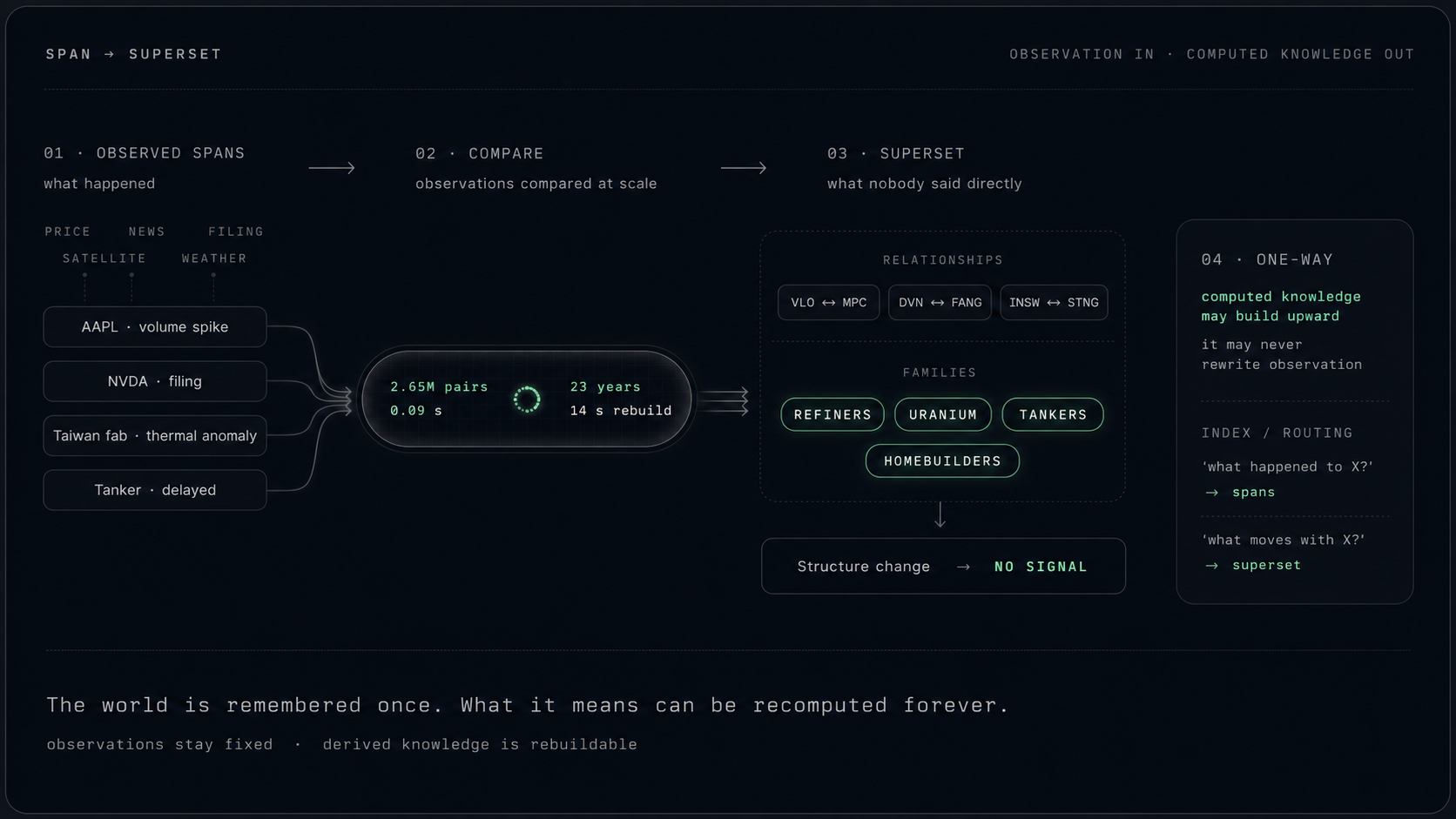
The world is remembered once. What it means can be recomputed forever.
Observations remain fixed. Derived knowledge can be discarded, rebuilt and corrected without rewriting history.
Applications
Wherever complex systems generate data.
Financial Markets
regime detection · narrative shifts
Every tick, headline, filing, and option print across entire markets, distilled into permanent memory. Hand it any name and any day; it reassembles what happened — the news, the trading, the positioning, the aftermath — from stored meaning, in seconds. Feed it ten years or thirty; it reads once and remembers.
Legal
evidence · testimony · citations · outcomes · one memory
Law runs on a torrent of timestamped evidence — dockets, opinions, depositions, exhibits, clauses, and the news and filings around them. The connections are the value: precedent flowing through citation networks, doctrines and templates forming families, matters unfolding as sequences with recorded outcomes, all on the same clock as the market's reaction. Same machinery as markets; only the vocabulary changes.
Read the field guide →Government & Regulatory
where every domain collides
Regulation is sprawling and it touches everything. A rule like Volcker is statute, rulemaking, compliance metrics, and live trading data at once — today scattered across departments that don't share a clock. On one timeline, the regulation connects directly to the behavior it governs: the rule, the debate that shaped it, the filings it demands, and the market data that proves compliance — one memory.
Agriculture
predictive to be protective
Soil probes, weather stations, satellite passes — millions of readings a season, mostly glanced at once and discarded. On one timeline, a dry-warm signature in block 7 matches the pattern that preceded the last two fungal outbreaks — eleven days before visible damage. Flagged in time to act. Nothing predicted for profit; something protected.
Logistics & Supply Chain
the physical chain, remembered
A delivery truck photographed at the same dock every Tuesday. One photo is nothing. Joined to delivery scans, inventory levels, and weather, the memory notices Tuesday runs late whenever a specific upstream hub had weekend backlog. Nobody asked; the substrate connected it.
Healthcare
longitudinal patient memory
A decade of one patient — every lab value, prescription, symptom note, wearable reading — on one timeline. The memory notices the fatigue reports always follow two weeks after a medication change, across visits, across doctors who each saw only one slice.
Industrial Systems
anomaly · failure topology
A pump's vibration ticks slightly odd — below every alert threshold. On the timeline, the same signature preceded two failures at sister plants, both about eleven days out. And the memory is honest the other way too: it records which warning signs never led to anything.
Scientific Research
discovery from sparse signal
Every experiment on one timeline — including the failed ones, recorded as first-class knowledge. The lab stops re-running dead hypotheses, and negative results stop vanishing into drawers.
Insurance & Claims
evidence with lineage
Photos, adjuster notes, weather data, repair invoices — one claim's whole life on a timeline. A thousand claims reveal which patterns are genuine and which body shops bill triple after hailstorms.
Sensor Networks
high-frequency event memory
Millions of readings a day, meaning extracted once, raw flushed. What persists: the events that mattered, the patterns that repeat, and an honest record of the alarms that never came true.
Agents
Air traffic control for agents.
Everyone is about to be running agents. Very few will be able to tell you what theirs are doing right now, what they were allowed to touch, or what they cost this morning.
AirPort is the control plane for them. An agent is declared, not coded: what it may read, what it may spend, what it has to report. It runs against the memory, comes back with a dated answer and its evidence attached, and cannot reach a thing it wasn't granted.
One board shows the whole airspace. What is running, what is holding, what came back with nothing, and what the fleet has spent today.
every agent declared · budgeted · answerable
Open by design
Bring your own intelligence.
The memory speaks an open protocol. Any model can use it: frontier, open source, or something small running on a box in your own building.
That last one is the point. Because the meaning has already been extracted, the model isn't doing the heavy lifting any more. It doesn't need to read a decade of filings to understand a decade of filings; it needs to read what those filings already meant. Work that used to demand the largest model available is now well within reach of a small open one, which changes what it costs to run, and where it's allowed to run.
Nothing has to leave your building. Nothing is locked to one vendor. Use the biggest model in the world for the hardest question, and a small local one for the other ten thousand.
Intelligence keeps getting cheaper. The memory stays yours.
same memory, any model · the expensive reading was already done
The size result
It doesn't throw everything at small models. It feeds them what matters.
The received wisdom says bigger models comprehend better. So we tested it: twelve thousand judgements, seven models, two families, each handed the same raw data. Fabrication does decline with size, smoothly, predictably. And it never reaches zero. The largest model we tested still asserted an answer to six percent of questions the evidence could not support.
Then we changed one variable. Not the model; the input. The same small model that failed on raw one-minute bars, fifty seconds to its first token, inventing bars it was never given, answered everything when handed the day as the memory stores it. A model small enough to sit in your pocket, 834 MB, refused cleanly what the evidence didn't contain, in half a second.
The deciding variable was never the size of the reader. It was whether the comprehension had already been paid.
Every model read the same raw data. The chart shows how often each one invented an answer it could not support.
Bigger models invent less. But none of them stop. The largest model we tested still made up 6% of its answers.
We changed one thing: the input, not the model. The same trading day, read from memory instead of raw bars.
same question · same day · only the input changed
Zero inference
When the answer is already exact, the right amount of AI is none.
Most questions people actually ask collapse onto a small number of intents. "Where did Nvidia peak after earnings?" and "What was NVDA's post-results high?" share almost no words, and want exactly the same maintained state.
When that state already exists, generating anything is a step backwards. A number paraphrased by a model is strictly less reliable than the number. So the system answers from the memory directly, and reserves the model for the questions that genuinely need one: synthesis, judgement, the unfamiliar.
The cheapest, fastest, most trustworthy inference is the inference you never run.
a number paraphrased by a model is strictly less reliable than the number
deterministic where it can be · generative only where it must be
The new infrastructure
Compute got faster. Memory didn't.
The world spent a decade building machines that think at extraordinary speed, then kept feeding them raw bytes and asking them to work out what it all means. Over and over. Forever.
AirPort is the other half of that build: a memory layer that already knows. Meaning is extracted once, typed, connected, and held where the fast silicon can reach it. The expensive thinking happens on what matters, not on re-reading what was already understood yesterday.
thinking layer ← value → basement
the thinking layer holds meaning · the basement holds the bytes
The new infrastructure
Compute got faster. Memory didn't.
The world spent a decade building machines that think at extraordinary speed, then kept feeding them raw bytes and asking them to work out what it all means. Over and over. Forever.
AirPort is the other half of that build: a memory layer that already knows. Meaning is extracted once, typed, connected, and held where the fast silicon can reach it. The expensive thinking happens on what matters, not on re-reading what was already understood yesterday.
thinking layer ← value → basement
the thinking layer holds meaning · the basement holds the bytes
Placement
Placement decided by value, not recency.
Memory has economics. In a GPU-accelerated world, the scarcest real estate is the fastest tier. AirPort's control plane treats data placement as an economic decision: the most valuable meaning lives closest to compute; evidence rests in the basement, reachable, never re-read.
The physical world
Your product, in the real world.
Customers and teams can feed in photographs, social posts, store shots and field notes from Instagram, TikTok or anywhere else. Lupo connects that real-world feedback to your product, campaign, inventory and sales data, so you can follow a product from creation to purchase to use, and continuously improve it. The same kind of object holds at any scale, from a single photograph to undersea cables, shipping chokepoints and factory floors.

- ✓User travelling
- ✓Transportation event
- ✓Evening arrival
- ✓Urban mobility context
Users frequently use rideshare services following social or dining activities.
Uber observed across 12 independent interactions over 4 months.
High rideshare activity within central Amsterdam entertainment districts.
Strong preference for rideshare over public transportation.
a photograph, a headline, a sensor reading, and a market event · the same kind of object here
Beyond the data stack
The world itself can become intelligence.
Lupo continuously transforms observations from the physical world into connected memory, relationships and understanding.
Photographs, conversations, documents, locations, movement, sensor readings and human experiences can all become part of a continuously evolving substrate of intelligence.
About
We are not building software. We are building a living memory system.
Lupo IO is a small team of researchers and engineers working on a fundamentally different way to handle data: as memory, not as records.
Our work sits at the intersection of semantic reasoning, recursive memory and explainable inference. The system never finishes learning.